
For the Construction industry OSHA regulations require protection when workers are exposed to falls 6ft or more. The regulations define specific hazards & outline acceptable ways of dealing with the hazards using the methods discussed.
Guardrail Systems
- Requirements for guardrail systems see illustration below.
- Guardrail systems must be surfaced so as to prevent injury from punctures or lacerations and snagging of clothing. Ends of top rails and mid-rails cannot overhang terminal posts, except where such overhang does not constitute a projection hazard.
- Top rails and mid-rails will be at least one-quarter inch nominal diameter or thickness to prevent cuts and lacerations. Wire rope top rails must be flagged at not more than six (6) foot intervals with high visibility material.
- Manila, plastic or synthetic rope used for top rails or mid-rails must be inspected as frequently as necessary to ensure it continues to meet strength requirements.
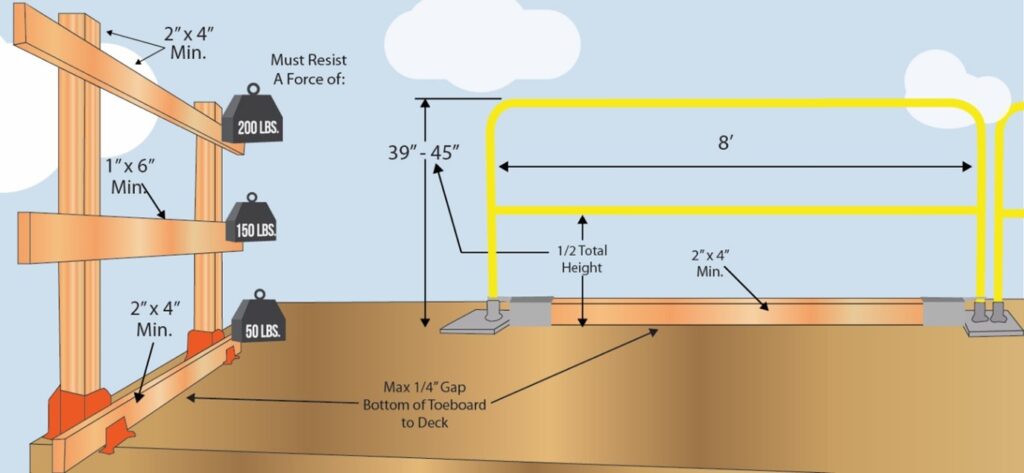
Figure 1. Guardrail Systems 29 CFR 1926.502(b)
Personal Fall Arrest Systems Tie-off Considerations
- One of the most important and often overlooked aspects of personal fall protection systems is fully planning a tie-off system before it is put into use.
- OSHA recognizes there will be a need to devise an anchor point from existing structures. Examples of what might be appropriate anchor points are steel members or I-beams if an acceptable strap is available for the connection (do not use a lanyard with a snap-hook clipped onto it).
- The strength of a personal fall arrest system is based on its being attached to an anchoring system which does not reduce the strength of the system (such as properly dimensioned eyebolt/snap-hook anchorage). If a means of attachment is used that will reduce the strength of the system, that component should be replaced by a stronger one, but one that will also maintain the appropriate maximum arrest force characteristics.
- Tie-off of a rope lanyard or lifeline around an “H” or “I” beam or similar support can reduce its strength as much as seventy percent (70%) due to the cutting action of the beam edges. Therefore, use should be made of a webbing lanyard or wire core lifeline around the beam; or the lanyard or lifeline should be protected from the edge; or free fall distance should be greatly minimized.
- Tie-off where the line passes over or around rough or sharp surfaces reduces strength drastically. Such a tie-off should be avoided or an alternative tie-off rigging should be used. Such alternatives may include use of a snap-hook/D-ring connection, wire rope tie-off, an effective padding of the surfaces, or an abrasion-resistance strap around or over the problem surface.
Best practice uses a Retractable Lanyard
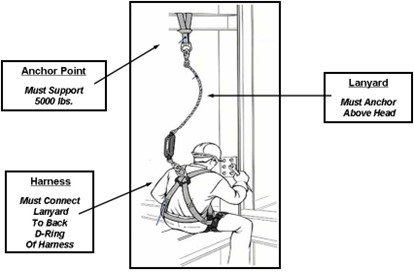
- D-rings and snap-hooks must have minimum strength of five thousand (5,000) pounds.
- Only locking type snap-hooks can be used.
- The attachment point of a body harness must be in the center of the wearer’s back near muster level, or above the wearer’s head.
- Harnesses and components must be used only for worker protection and not to hoist materials. Personal fall arrest systems and components subjected to impact loading must be immediately removed from service and not be used again for worker protection until inspected and determined by a competent person to be undamaged and suitable for reuse.
- Personal fall arrest systems must be inspected prior to each use for wear, damage, and other deterioration. Defective components must be removed from service.
- Personal fall arrest systems cannot be attached to guardrail systems.
- Anchorage points must be capable of supporting five thousand (5,000) pounds.
- Anchorage points must be at a point above the workers shoulders.
- Horizontal lifelines must be designed, installed, and used under the supervision of a qualified person.
- Lanyards and vertical lifelines must have a minimum breaking strength of five thousand (5,000) pounds.
- When vertical lifelines are used, each worker must be attached to different lifelines.
- Lifelines must be protected against being cut or abraded.
- Self-retracting lifeline and lanyards that automatically limit free fall distance to two (2) feet or less must be capable of sustaining a minimum tensile load of three thousand (3,000) pounds.
- Self-retracting lifelines and lanyards which do not limit free fall distance to two (2) feet will be capable of sustaining a minimum tensile load of five thousand (5,000) pounds
Covers
Hole is defined as a gap or void two (2) inches or more in its least dimension in a floor, roof, or other walking/working surface. Covers for holes in floors, roofs, and other walking/working surfaces must meet the following requirements:
- Covers located in roadways and vehicular aisles must be capable of supporting, without failure, at least twice the maximum axle load of the largest vehicle expected to cross over the cover.
- All other covers must be capable of supporting, without failure, at least twice the weight of workers, equipment, and materials that may be imposed.
- All covers must be secured when installed to prevent accidental displacement by wind, equipment, or workers.
- All covers must be color or marked with the word “HOLE” or “COVER” to provide warning of the hazard.
Protection from Falling Objects
Protection from falling objects shall include the following provisions:
- Hard-hats must be worn.
- Toe-boards, when used, must be erected along the edge of the overhead walking/working surface for a distance sufficient to protect workers below.
- Toe-boards must be capable of withstanding, without failure, a force of at least fifty (50) pounds applied in a downward or outward direction from any point.
- Toe-boards must be a minimum of 3-1/2 inches in vertical height with not more than inch clearance above the walking/working surface.
- Toe-boards must be solid or have openings not over one inch at its greatest dimension.
- Where tools, equipment, or materials are piled higher than the top edge of a toe-board, paneling or screening must be erected to the top of a guardrail system’s top rail or mid-rail, for a distance sufficient to protect workers below.
- Guardrail systems, used as falling object protection, must have openings small enough to prevent passage of potential falling objects.