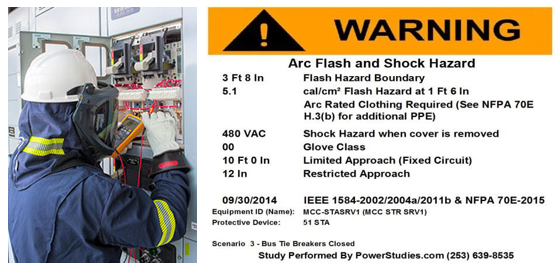
Electricity KILLS. Electrocution means DEATH. The current required to light a 7½ watt, 120-volt lamp, if passed across the chest is enough to cause a fatality. Electrocution is fourth leading cause of industrial fatalities in work related fatalities with a majority of these incidents occurring at 600 volts or less. 7,600 disabling and non-disabling electrical injuries occur in the US each year. OSHA Published top 10 most violated standards. Electrical violations are ranked number four.
One who has skills and knowledge related to the construction and operation of the electrical equipment and installation and has received safety training to recognize and avoid the hazards involved. This does not automatically authorize an employee to perform a task.
One who is not qualified. Not Trained and unfamiliar with any of the electrical safety related practices. Not permitted to enter approach boundaries.
A person approved or assigned by the employer to perform a specific type of duty or duties or to be at a specific location or locations at the jobsite.
Familiar with proper use of special precautionary techniques, PPE (including arc-flash, insulated, and shielding materials, insulated tools and test equipment). Skills and techniques to determine nominal voltage of exposed energized conductors and equipment. Approach distances (limited, restricted, and prohibited), etc. (NFPA 70E (2009) Article 110.6(D))
General: Safety-related work practices shall be employed to prevent electric shock or other injuries resulting from either direct or indirect electrical contacts. Only qualified and trained personnel shall be permitted to perform lockout tagout and energized work permits.
De-energized parts: Live parts, to which an employee may be exposed, shall be de- energized before the employee works on or near them. Unless the employer can demonstrate the de-energizing introduces additional or increased hazards or is infeasible due to equipment design or operational limitations.
Live parts which operate at less than 50 volts to ground not be de-energized if there will be no increased exposure to electrical burns or to explosion due to electric arcs.
Energized parts: If the exposed live parts are not de-energized, other safety related work practices shall be used to protect employees who may be exposed to the electrical hazards involved. Such work practices shall protect employees against contact with energized circuit parts directly with any part of their body or indirectly through some conductive object.
Working on or near energized parts: Conductors and parts of electric equipment that have been de-energized but have not been locked out or tagged shall be treated as energized parts. NOTE: Working on or near energized electrical circuitry or components must be deemed infeasible and considered as a last resort. Strict adherence to Doggett energized work permit is expected at all times.

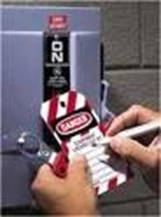
Lockout / Tagout: While any employee is exposed to contact with parts of fixed electric equipment or circuits which have been energized, the circuits energizing the parts shall be locked out or tagged, or both, in accordance with company and owner lockout / tagout procedures.
Remember! To control the source and protecting workers only one key per lock is required. The qualified person that installs the lock and tag on the circuit breaker shall be in sole possession of the key at all times.
Electrically safe work condition does not exist until all of the six steps are satisfied. Until then, workers might contact an exposed live part. According to NFPA 70e, if an electrically safe work condition does exist, no electrical energy is in proximity of the work task(s). All danger of injury from an electrical hazard has been removed, and neither protective equipment nor special training is required. However, other hazards might remain.
Step #1: Determine all possible sources of electrical supply to the specific equipment. Check all applicable up-to-date drawings, diagrams, and identification tags.
Step #2: After properly interrupting the load current, open disconnecting device(s) for each source.
Step #3: Wherever possible, visually verify that all blades of the disconnecting devices are fully open or that drawout-type circuit breakers are withdrawn to the fully disconnected position. Note: Ensuring that operating the handle device actually establishes a physical break in all conductors is critical.
Step #4: Apply lockout/tagout devices in accordance with a documented and established policy. Strict adherence to Adam’s lockout/tagout policy must be enforced.
Step #5: Use an adequately rated voltage detector to test each phase conductor or circuit part to verify they are deenergized. Test each phase conductor or circuit part both phase-to-phase and phase-to-ground. Before and after each test, determine that the voltage detector is operating satisfactorily. Note: The voltage-detecting device must be functionally tested before taking the measurement and then again after the measurement is taken to ensure that the voltage detector is working satisfactorily.
Step #6: Where the possibility of induced voltages or stored electrical energy exists, ground the phase conductors or circuit parts before touching them. Where it could be reasonably anticipated that the conductors or circuit parts being deenergized could contact other exposed energized conductors or circuit parts, apply ground connecting devices rated for the available fault duty.