
General: The exact location of all utility installations such as: sewer, telephone, fuel, electric, and water lines shall be determined prior to opening an excavation. Doggett PTP and Excavation Work Permit must be utilized on all trenches and excavations. Refer to Doggett’s EH&S excavation chapter for details.
A spotter must be utilized during all phases of digging operation.
Dig with shovel around trenches or excavations that identify utilities via applicable markings. See utility marking chart below.

A stairway, ladder, ramp, or other safe means of egress shall be located in all trench excavations that are four feet or more in depth. All forms of egress shall require no more than 25 feet of travel to access them.
In areas with potentially hazardous atmospheres, such as landfill areas or areas where hazardous substances are stored nearby, the atmosphere must be tested before employees enter excavations four feet deep or more.
Employees shall not work in excavations in which there is accumulated water, or in excavations where water is accumulating, unless adequate precautions have been taken.
Precautions such as shield systems to prevent cave-ins, and water removal devices shall also
be monitored by a competent person to ensure proper operation.
Employees exposed to public vehicular traffic shall be provided with, and shall wear, warning vests or other garments marked with or made with reflective or high visibility material.
No employee shall be permitted underneath loads handled by lifting or digging equipment.
Support systems such as shoring, bracing, or underpinning shall be provided to ensure stability when excavation operations threaten the stability of adjoining buildings, walls, or other structures.
Walkways shall be provided where employees or equipment are required or permitted to cross over excavations. Guardrails that conform to the specifications outlined in 1926.502 shall be provided where walkways are six feet or more above lower levels.
All shields and shield systems shall be either pre-manufactured or job-built in accordance with 1926.652(c)(3) or (c)(4).
No employees shall dig or enter an excavation without the proper authorization of management.
A competent person, who has been so designated by management, shall conduct daily inspections of excavations, the adjacent areas, protective systems, hazardous atmospheres, or other hazardous conditions. Inspections shall also be made after every rainstorm or other occurrence that may increase hazards.
No employees shall enter an excavation until a competent person has determined the soil type present and has taken appropriate protective measures for workers in said excavations.
The competent person shall make sure that all soil piles are more than two feet from the edges of excavations.
A competent person shall inspect all material or equipment used for protective systems that is damaged or is suspected to be damaged and evaluate its suitability for continued use.
For the purpose of describing its stability, soil has been classified into four categories: Type A, Type B, Type C and Stable Rock. The characteristics of each of the categories are listed below:
o Solid mineral matter. Can be excavated with vertical sides and remain intact while exposed.
Cohesive soil. Unconfined compressive strength of 1.5 tons per square foot or greater.
Cohesive soil with an unconfined compressive strength greater than 0.5 tons per square foot. Previously disturbed soils except those which would otherwise be classed as Type C soil. Dry rock which is not stable.
Type C soil characteristics
Cohesive soil with an unconfined compressive strength of 0.5 tons per square foot or less. Submerged soil or soil from which water is freely seeping Granular soils including gravel, sand, and loamy sand
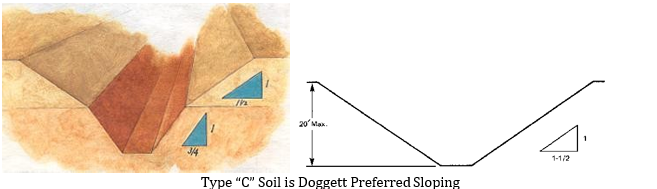
| SOIL OR ROCK TYPE | ||
| Stable Rock | Vertical | (90 degrees) |
| Type A | ¾ : 1 | (53 degrees) |
| Type B | 1:1 | (45 degrees) |
| Type C | 1 ½ : 1 | (34 degrees) |