
LADDER SAFETY
General Requirements for Ladders
- ALL ladders shall be Non-Conductive Fiberglass ladders.
- Inspect before use for physical defects.
- Ladders are not to be painted except for numbering purposes.
- Do not use ladders for skids, braces, workbenches, or any purpose other than climbing.
- When you are ascending or descending a ladder, do not carry objects that will prevent you from grasping the ladder with both hands.
- Always face the ladder when ascending and descending.
- If you must place a ladder over a doorway, barricade the door to prevent its use and post a warning sign.
- Only one person is allowed on a ladder at a time.
- Do not jump from a ladder when descending.
- All joints between steps, rungs, and side rails must be tight.
- Safety feet must be in good working order and in place.
- Rungs must be free of grease and/or oil.
- Do not place tools or materials on the steps or platform of a stepladder
- Do not use the top two steps of a stepladder as a step or stand.
- Always level all four feet and lock spreaders in place.
- Do not use a stepladder as a straight ladder.
Duty rating and safety/operating instruction stickers are required on all ladders and must be replaced if damaged or illegible.
Figure 2 2 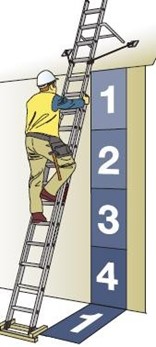
Figure 3
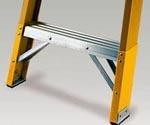
Figure 4
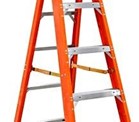
Figure 5
Self-supporting (foldout) and non-self-supporting (leaning) portable ladders must be able to support at least four times the maximum intended load, except extra-heavy-duty metal or plastic ladders, which must be able to sustain 3.3 times the maximum intended load. (See Figure 1.
Non-self-supporting ladders, which must lean against a wall or other support, are to be positioned at such an angle that the horizontal distance from the top support to the foot of the ladder is about 1/4 the working length of the ladder. (See Figure 2.)
In the case of job-made wooden ladders, that angle should equal about 1/8 the working length. This minimizes the strain of the load on ladder joints that may not be as strong as on commercially manufactured ladders.
Ladder rungs, cleats, or steps must be parallel, level, and uniformly spaced when the ladder is in position for use. Rungs must be spaced between 10 and 14 inches apart.
For extension trestle ladders, the spacing must be 8-18 inches for the base, and 6-12 inches on the extension section.
Rungs must be so shaped that an employee’s foot cannot slide off and must be skid-resistant. (See Figure 3.)
Ladders are to be kept free of oil, grease, wet paint, and other slipping hazards.
Wood ladders must not be coated with any opaque covering, except identification or warning labels on one face only of a side rail.
Foldout or stepladders must have a metal spreader or locking device to hold the front and back sections in an open position when in use. (See Figure 4.)
Figure 4
Figure 5
When two or more ladders are used to reach a work area, they must be offset with a landing or platform between the ladders.
The area around the top and bottom of ladder must be kept clear.
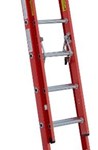
Ladders must not be tied or fastened together to provide longer sections, unless they are specifically designed for such use. (See Figure 5.)
Never use a ladder for any purpose other than the one for which it was designed.
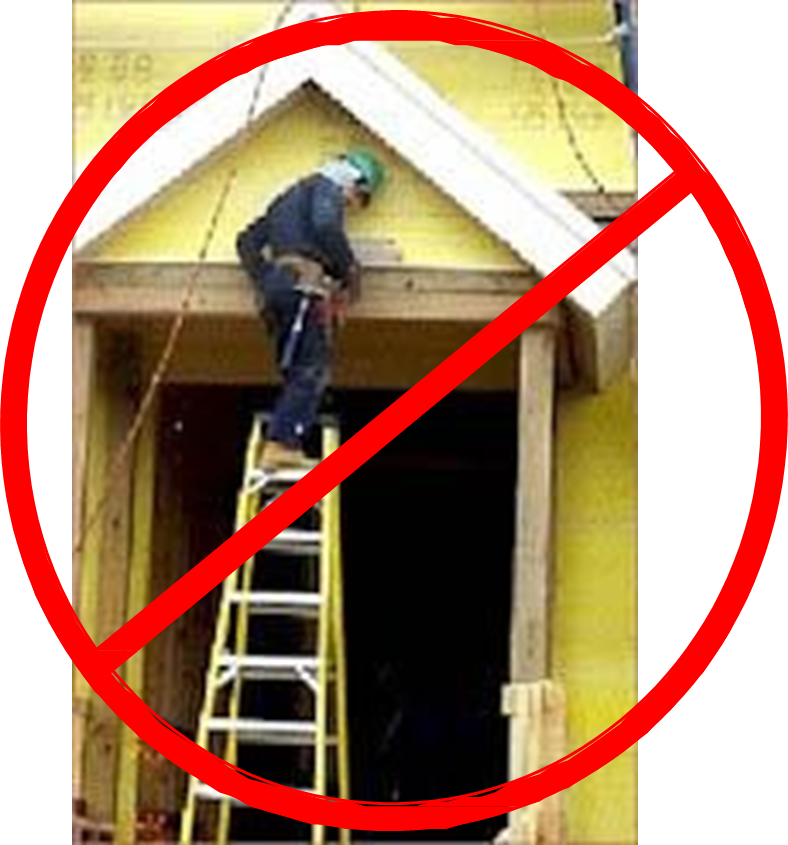
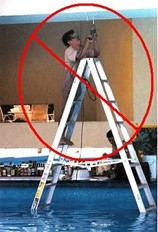
Above two pictures are unsafe acts
Straight type or extension ladders
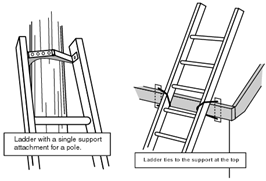 | Use help in setting up the ladder.Any Ladder over fifty pounds requires two-person lift.Set the base of ladder on firm level surface.Top portion of ladder shall extend 3 ft above working surface. Tie off top of the ladder.Face ladder when climbing up or down, maintain a firm grip, use both hands when climbing or descending.Avoid pushing or pulling off to one side of the ladder. Do NOT walk or shift ladder while on the ladder. |
(Important Tip: Always keep 3 parts of the body in contact with the ladder when climbing. Hold on with (2) hands, (1) foot or (2) feet & (1) hand).
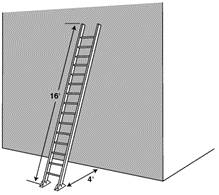 Portable ladders must be used at such a pitch that the horizontal distance from the top support to the foot of the ladder is about one-quarter of the working length of the ladder. | 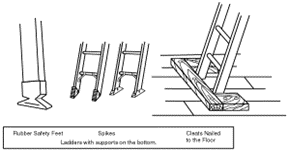 All ladders must be equipped with safety (non-skid) feet. |